
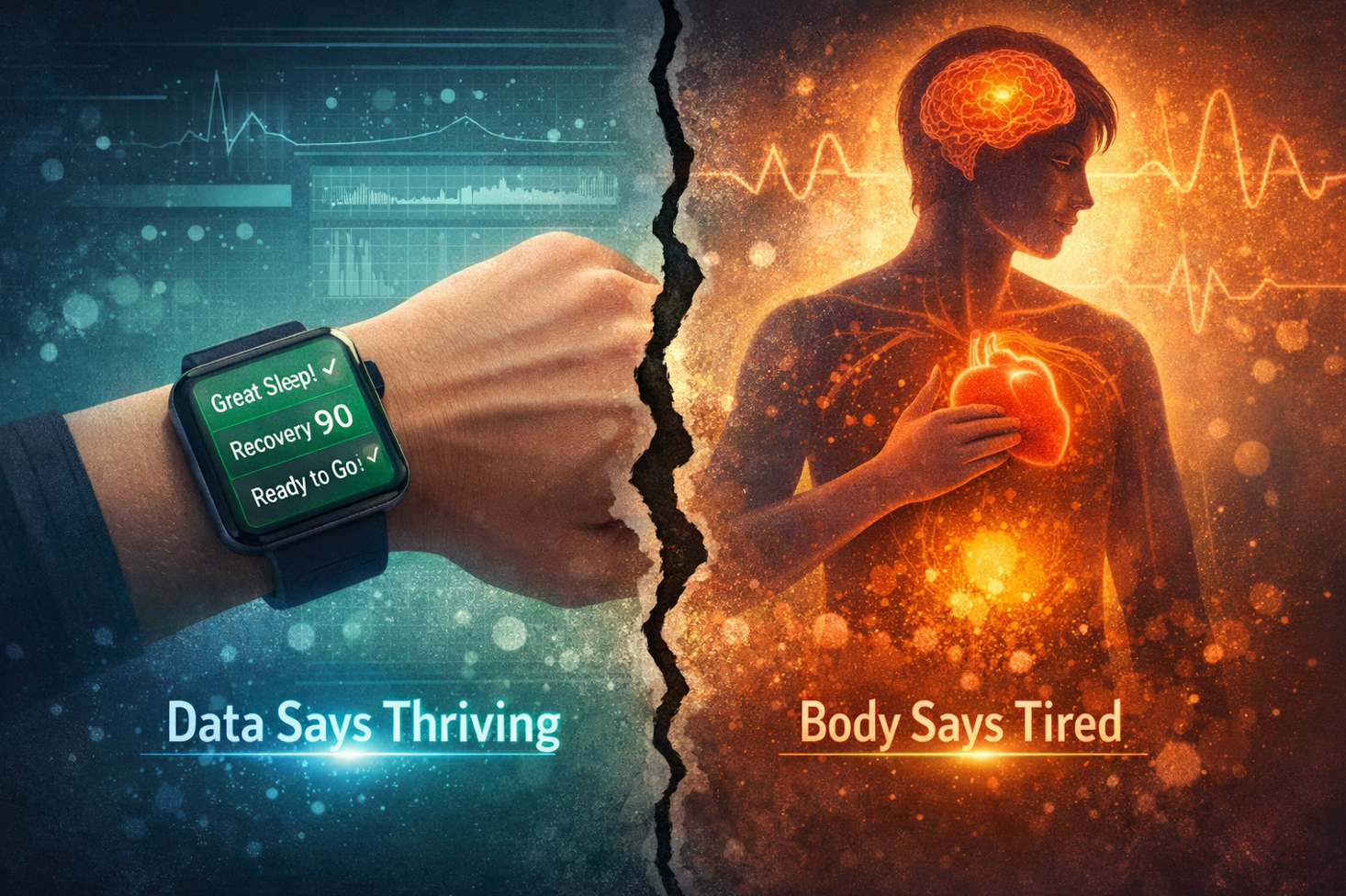
𝙄𝙣𝙩𝙚𝙡𝙡𝙞𝙜𝙚𝙣𝙩 𝙃𝙚𝙖𝙡𝙩𝙝 is arriving at exactly the right moment. For the first time, we can see the whole person by unifying clinical data with the signals of daily life; we can apply intelligence to that data to generate insight and foresight; and we can finally put people in control, with tools designed to serve human goals, rather than institutional convenience. This shift has the potential to move health from reactive and episodic to predictive, preventive, and deeply personal. Done well, Intelligent Health restores agency, clarity, and partnership to people navigating their own health. But there is a quiet risk embedded in this progress: as we become more connected to our data, we risk becoming less connected to ourselves. I’ve had mornings when my wearable told me I slept beautifully—green checkmarks everywhere, “ready to take on the world”—while my body felt heavy, foggy, and depleted. I’ve also had days when the data revealed a night of poor sleep, low recovery, and elevated stress, only for me to head out the door and have one of the best runs I’ve had in months: fluid, strong, joyful. The numbers were confident. My body told a different story. Both times, the most important signal wasn’t my technology: it was inside me. That tension points to the deeper truth: Intelligent Health must augment, not replace, our embodied intelligence. Our capacity to notice fatigue, energy, intuition, pain, and resilience is not noise to be filtered out. It is foundational data shaped by evolution, experience, and context that no sensor can fully capture. The future of health depends not just on better algorithms, but on preserving our ability to listen inward while looking outward. The most powerful model is not humans obeying machines, nor machines ignoring humans, but a partnership where technology sharpens awareness and the body remains the final authority. 𝗜𝗻 𝘁𝗵𝗲 𝗲𝗻𝗱, 𝗶𝗻𝘁𝗲𝗹𝗹𝗶𝗴𝗲𝗻𝗰𝗲 𝘄𝗶𝘁𝗵𝗼𝘂𝘁 𝗲𝗺𝗯𝗼𝗱𝗶𝗺𝗲𝗻𝘁 𝗶𝘀 𝗼𝗽𝘁𝗶𝗺𝗶𝘇𝗮𝘁𝗶𝗼𝗻; 𝗶𝗻𝘁𝗲𝗹𝗹𝗶𝗴𝗲𝗻𝗰𝗲 𝘄𝗶𝘁𝗵 𝗲𝗺𝗯𝗼𝗱𝗶𝗺𝗲𝗻𝘁 𝗶𝘀 𝘄𝗶𝘀𝗱𝗼𝗺.

Three Things the Core Healthcare Ecosystem Must Do This is the first in a series on how every part of the healthcare ecosystem must evolve in the Intelligent Health revolution—from care delivery and caregivers to payers, employers, life sciences, technology, retail, and policy. In my upcoming book Intelligent Health, I argue that healthcare is on the cusp of its most consequential transformation. This is not because of another breakthrough drug or device, but because we can finally see the whole person. For the first time, we can unify the 20% of what determines a person’s health—data generated inside healthcare systems—with the 80% shaped by daily life: our behaviors, environments, stress, genetics, and social context. That life context now flows continuously through apps, wearables, connected devices, and everyday digital interactions, capturing how people actually live, not just how they show up to a clinic. When this unified data is paired with intelligence, AI can generate insight about today and foresight about tomorrow. Healthcare has long been built on hindsight—proving what went wrong after harm occurs. Intelligent Health shifts us toward foresight, acting earlier on what is predictable and preventable. This enables something healthcare has never truly offered: a 24/7, evidence-based coach and partner aligned to a person’s health goals. This is Intelligent Health. And it is not a new layer of technology on top of a broken system; it is a reordering of the system around the only constant in health and care: the individual. If this is the destination, the question becomes clear: what must the core healthcare ecosystem fundamentally change to get there? 1. Move from Episodic Care to Continuous Partnership (Care Teams) The first shift demands a redefinition of how clinicians and care teams deliver care. Today’s model is episodic, reactive, and cognitively crushing—brief visits for people with increasingly complex medical and social needs, separated by long stretches of silence where health can quietly deteriorate or suddenly spiral into crisis. In an Intelligent Health world, health and care become continuous. Signals from daily life—symptoms, activity, medication adherence, environmental exposure—are translated into meaningful patterns that surface early risk and guide timely action. Physicians are no longer forced to practice medicine in 15-minute fragments; they regain the ability to think longitudinally, make nuanced decisions, and partner with people over time. Nurses and allied professionals become the operational backbone of prevention, managing panels of patients through early intervention and coaching rather than crisis response. Care teams stop chasing information and start acting on it. By making prevention, coordination, and follow-through visible and measurable, Intelligent Health turns work that was once unpaid and invisible into core, valued clinical labor. Intelligence does not replace clinical judgment; it restores it—filtering noise, reducing cognitive overload, and allowing humans to do what they do best: decide, connect, and care. 2. Shift from Facilities and Volume to Sustained Health (Healthcare Delivery Systems) The second shift requires healthcare delivery systems to evolve from operators of buildings and beds to partners in sustained health. Today, hospitals are structurally rewarded for volume, complexity, and occupancy—even when their mission statements proclaim prevention and community health. Intelligent Health makes this contradiction untenable. When real-time population data reveals emerging risk—rising respiratory symptoms across neighborhoods, worsening chronic disease control, early signs of post-discharge complications—systems can act before demand overwhelms them. Staffing models shift from historical averages to forward-looking forecasts. Discharge becomes a transition within continuous care, not the end of responsibility. The relationship with the individual no longer stops at the hospital door. Financial models evolve accordingly. Prevention is no longer a financial liability; it becomes a reimbursed, sustainable business strategy. Health systems are rewarded for avoided admissions, safer recoveries, and healthier days at home. This is not about sacrificing margins for morality—it is about aligning economics with outcomes so that prevention, coordination, and follow-through finally make financial sense. 3. Elevate Caregivers from Invisible Labor to Supported Partners (Family Caregivers) Perhaps the most underrecognized transformation in the Intelligent Health revolution is what becomes possible for family caregivers. Today, caregivers absorb enormous cognitive and emotional labor—coordinating appointments, tracking symptoms, translating instructions. This work is largely unseen and unpaid. They become the system’s memory, logistics engine, and safety net, often while holding full-time jobs and caring for other family members. Intelligent Health brings caregivers into the system with permission, clarity, and support. Guidance becomes timely, personalized, and actionable—delivered through channels that fit real lives. Instead of reacting to crises, caregivers receive early signals, clear priorities, and simple checklists that explain what to do, what to watch for, and when to escalate. Their contributions are visible, trackable, and integrated into the care plan. This is not surveillance or oversight imposed from above; it is permissioned presence—intelligence invited by the individual to support their health goals. Caregiving is transformed from a lonely act of vigilance into a supported partnership in prevention and health. The Hard Part—and the Necessary One None of this is easy. The technology is ready; the resistance is human and institutional. Power must shift. Incentives must change. Data must move securely, ethically, and with consent toward service of the individual. Clinicians must trust intelligence without surrendering judgment. Organizations must let go of business models that depend on sickness to survive. And leaders must be willing to design for long-term health rather than short-term revenue. The cost of inaction is no longer abstract: a system that exhausts its workforce, bankrupts its institutions, and fails the people it claims to serve. The Intelligent Health revolution offers a different future—one where health and care are continuous, humane, and aligned with what actually matters in people’s lives. The question is no longer whether this future is possible. It is whether we have the courage to build it.
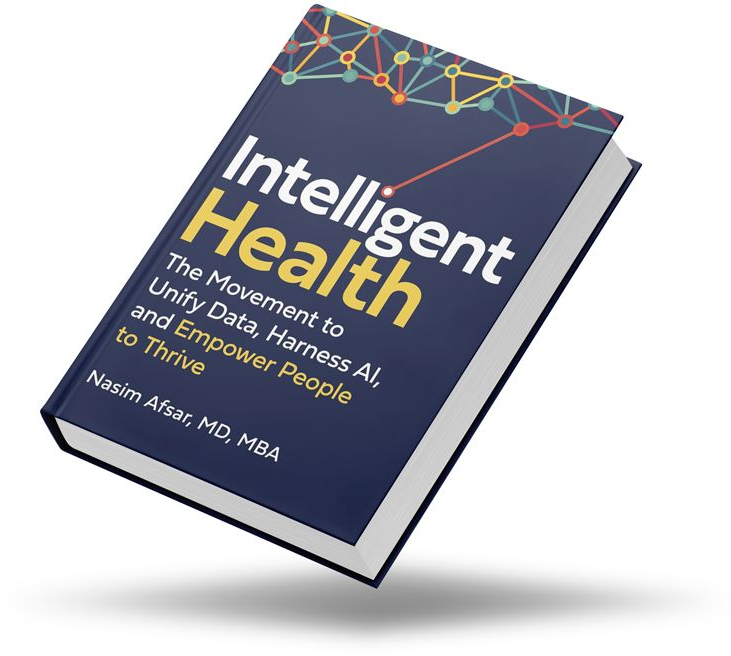
The Book
Intelligent Health makes an uncompromising case that unifying all of your health data, applying intelligence to it, and owning it outright is no longer optional―it's essential to improving outcomes, lowering costs, and restoring humanity to care. Drawing on compelling stories, actionable strategies, and deep expertise―shaped by two decades of executive roles in healthcare delivery and health tech, partnerships with White House and global health agencies this book is both a blueprint for transformation and a rallying cry for consumers of health and care, innovators, investors, policymakers, and health and care leaders alike.